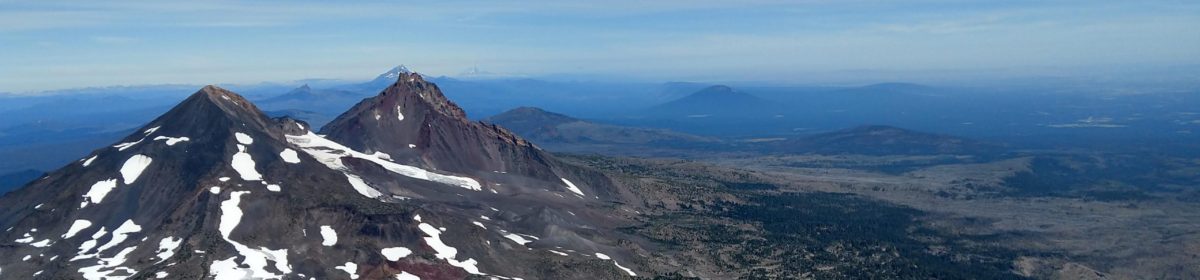
View from Coyote Wall of Mount Hood and the Columbia River
A Plethora of Curiosities
One of my favorite hikes in “The Gorge” takes you through a Missoula flood inflicted scablands of oak and pine, up a ridge of columnar basalt, and through fields of wildflowers. Oh and did I mention, views of Mount Hood and the Columbia River. There is a lot to appreciate along the Coyote Wall trail near Bingen, Washington. So today, let’s explore a few trail curiosities that can be found along the Coyote Wall trail.
The Hike at a Glance
Trailhead: Coyote Wall Trailhead
Distance: 7.8 miles
Elevation Gain: about 1900 feet
Notes: No parking pass required, but popular trail so get here early. Trail is shared with mountain bikers. Pit toilet at the trailhead.
The Wall (not just a Pink Floyd Album)
One of the most obvious and interesting curiosities to discover at Coyote Wall is the wall itself. Formed from ancient lava flows that flooded the area about 16 million years ago, the resulting basalt rocks underwent folding and faulting, and later uplift (both of which continue today), creating this magnificent geological feature. You can see Coyote Wall from the parking lot and again later when you climb up and back down it. It truly is a wonder and a highlight of this hike.
If you are so Inclined
You see, Coyote Wall is part of the Bingen Anticline- where the earth’s crust has been compressed, folded and uplifted by faulting. The Columbia River corridor east of Hood River is characterized by convex ridges (anticline) and concave valleys (synclines) formed from a north-south compression of the Earth’s crust. To understand how this works, take a flat piece of paper, or other flexible material, and bring its opposite ends together- the paper will “deform” much like the deformation of the Earth’s crust under similar strain.
As part of the Yakima Fold Belt, the Bingen Anticline is asymmetrical. Thus the Coyote Wall ridge is relatively short (maybe a mile or two), compared to the larger associated syncline valley that the town of Mosier occupies across the river (syncline valleys in the area tend to be 10s of miles). But don’t let it’s length fool you, uplifted Coyote Wall is a steep climb and descent having been uplifted a couple hundred feet!
Looking back at Coyote Wall
The Labyrinth (not just an 80’s cult classic)
The Labyrinth
But let’s not get ahead of ourselves- first is the Labyrinth! Before beginning the steep climb up Coyote Wall, a trail to the east leads you through another fascinating geological feature- a channeled scablands. Curiosity number two!
Throughout southeast Washington, channeled scablands dominate the landscape. Basically, channeled scablands are areas where parts of the soil and bedrock have been torn up, leaving exposed rocks and deep ravines. How did these scablands form? What happened here? You might have guessed it- water! And lot’s of it.
Sculpting with Water
During the last ice age 10,000 to 20,000 years ago, massive floods scoured the landscape. At that time, the Cordilleran ice sheet covered large swaths of North American- but it wasn’t static. This ice sheet would periodically inch its way southward, creating an ice dam along the Clark Fork River in Montana. The water behind the dam would accumulate into a large lake, the massive Glacial Lake Missoula. At roughly 2,000 feet deep, it held about 500 cubic miles of water. Then, periodically, the ice dam would fail, releasing torrents of water and ice. The flood waters tore through Washington and Oregon eroding much of the landscape and depositing materials as far south as the Willamette Valley.
With many areas of exposed basalt and butte-and-basin topography, the Labyrinth offers a glimpse into the powerful force of these episodic floods.
Wild about Wildflowers
Desert Parsley – Lomatium
Finally (but not least), are the wildflowers! I am a huge fan of wildflower hikes- and Coyote wall puts on a gorgeous show starting in the early spring. Among my favorite of the early bloomers (sometimes seen as early as February) are a diverse group of carrot family plants commonly called Desert parsley. I don’t know how many species of Desert parsley, or Lomatium, can be found along the Coyote Wall trail. But I saw a couple species on my recent visit, and I am pretty sure there are many more- as there are over 70 known species in the west. Rumor has it they can be difficult to identify. To be honest, I didn’t even try.
Better than Carrots
Anyway, besides being beautiful to look at, Lomatium also has an interesting history. The tap root of many Lomatium species was both food and medicine to many Pacific Northwest tribes. For example, the Yakama, who once occupied SE Washington, would use the root of Lomatium, also called biscuitroot or kowsh (yes, there are a lot of names for this stuff), to make small biscuits. The starchy roots of Lomtium were mashed, shaped, and dried in the sun. Then the biscuits were stored for later use.
I Think… Probably?
Early reports of Lomatium came from none-other-than Merriweather Lewis and William Clark. Lewis and Clark called the biscuits derived from the root “chapelel bread” and witnessed its preparation and trade. They also reportedly obtained and consumed some chapelel during their journey. In addition, Lewis collected and described five Lomatium species for his herbarium. Although it seems he too had difficulty distinguishing between species- using qualifiers in his records such as “I think” or “probably” when attempting to identification. I’m glad I am not the only one. Though the purple Lomatium pictured below is Columbia desert parsley, Lomatium columbianum… “I think… probably.”
Lomatium columbianum
Get Curious and Explore
In any event, from huge lava flows to massive floods of water to fields of edible vegetation, there is a lot of science and historical curiosities to explore at Coyote Wall. Botanically and geologically interesting, it is worth a visit. Stay curious!
The skies were clear blue as I headed out to meet with volcanologist Mariah Tilman for our hike at Shellburg Falls. In the distance, I caught a glimpse of snow capped Mount Jefferson, the second tallest Cascade volcano in Oregon. Though we weren’t going to get up close to this behemoth during our hike, I wondered if our walk in the foothills of the Cascades might offer a glimpse into Jefferson’s power. What forces are responsible for the formation of the Cascade peaks? Are these same forces at work in other parts of Oregon? Would we see any evidence of past volcanism during our hike through a humble state forest? Little did I know, I was about to enter the “blast zone” when it comes to volcano knowledge.
The Hike
Hike at a Glance
Trailhead: Shellburg Falls Trailhead
Distance: about 2.8 round trip. Out and back trail.
Elevation Gain: about 400 feet
Notes: There is no restroom at the trailhead. Parking is limited. Part of the hike is on private property so stay on trail. There are many variations to this hike with options for more mileage.
Mariah Tilman on the Shellburg Falls trail.
Volcanology Basics
The Shellburg Falls trail begins on a road through private pasture land before entering the forest. As we made our way through this area, Mariah and I talked a bit about what it is like to be a volcanologist, as well as why the profession is so important.
Of course, the job of a volcanologist is to study volcanoes. There are five USGS volcano observatories, all found in the western U.S., including the Cascades Volcano Observatory in Vancouver, WA. The main goal of these observatories is to monitor volcanic activity in order to predict and assess the risk associated with volcanic eruptions.
How do they do it? According to Mariah, there are a lot of tools a volcanologist will use to size up volcanic risk. Among the most important tools are seismometers. These can be placed throughout the landscape in order to detect movement of the earth, and give us an idea of what is happening below the surface. Another tool that is used is satellite imagery. Satellite imagery can be especially useful in monitoring the activity of volcanoes in remote areas, like Alaska, which has 52 active volcanoes, most of which are part of the hard to reach Aleutian islands.
Safety First
Public safety is the primary reason we study volcanoes. Besides the threat of lava and pyroclastic flows near the erupting volcanic vent, lahars- a hot mix of water and volcanic debris- can travel dozens of miles. If an eruption occurred during our hike, a lahar from Mt. Jefferson could easily travel far enough to reach us and neighboring towns. Yikes!
Then there is ash. Ash has the ability to travel large distances causing widespread disruption of natural and human systems. As Mariah explained, ash can be especially problematic for air traffic. In 1989, two jetliners nearly went down in an ash cloud generated by the eruption of Mount Redoubt in Alaska.
Fortunately, since the famous Mount Saint Helens eruption of 1980, scientists are better equipped to monitor and predict volcanic eruptions, sometimes even a year in advance. Given enough warning, communities can at least prepare for the onslaught.
With Mt. Jefferson looming “a little too close for comfort,” I asked Mariah if we should be concerned about it erupting. She reassured me that none of the Cascade peaks are currently predicted to erupt anytime soon. Phew!
It’s All Downhill
A small pile of angular rocks found along the trail.
As we made our way into the forest, we encountered our first geological phenomenon- the remnants of an old landslide. Landslides occur when the shape of the land, climate, and geology work in concert to weaken the connection between overlying sediment and material beneath. When this occurs, gravity takes over, moving earth materials downhill where they accumulate. Though people often think of geology as the building up of land through plate tectonics and volcanism, the wearing down of the land by weathering and the movement of land by erosion, are also important geological processes.
But how do we recognize a wearing down process, like a landslide, in nature? What can we observe to understand the geological activity of a place? I asked Mariah what to look for.
Think like a Geologist
She explained, one of the best ways to begin thinking like a geologist is to look for patterns in the landscape. Differences in the landscape are important evidence to understand the geology of a place. Though the area where the landslide had occurred in the past was now overgrown with trees, moss, and other vegetation, Mariah pointed out that the shape of the land had changed.
There were other landslide clues as well. First, Mariah and I observed many large rocks strewn about the base of the hillside. Unlike in a river, where sediments are sorted by size as the river loses energy downstream, rocks in a landslide lose energy abruptly, falling into a jumbled piles. Second, the shape of the rocks was angular. Landslides happen quickly, so rocks in a landslide will be angular, instead of worn down and smooth.
Hotspot or Subduction?
Rock outcropping along the trail.
As we continued our hike past the landslide, the shape of the land changed again . We started noticing outcroppings or rock of unknown origin to the left of us. Mariah and I began to speculate- How did these rocks form? Where did they come from?
Mariah narrowed down the source of these outcroppings to two likely possibilities. First, about 16.7 to 5.5 million years ago it is believed that the Yellowstone hotspot was under the Oregon-Idaho-Nevada border. This hotspot resulted in huge floods of basalt lava to cover large swaths of Oregon.
Secondly, about 35 million years ago and again 7 million years ago, tectonic activity along the Cascadia subduction zone built up the old and new Cascade volcanoes. Subduction occurs when an oceanic plate plunges beneath an overriding plate. As the descending plate heats up in the mantle it “sweats,” resulting in a build up of gases and pressure- the perfect conditions for explosive volcanic eruptions characteristic of the Cascades and other stratovolcanoes.
Igneous Rocks, Rock!
The dark color of these rocks are a clue that we are looking at basalt.
Though Mariah wasn’t 100% sure the origin of the rocks in the Shellburg Falls area, one thing was certain- these were igneous rocks. In general, rocks can be classified as igneous (molten rock that has cooled), metamorphic (rock that has been subjected to intense heat and pressure), or sedimentary (rock formed from compacted sediments). However, rocks can also be further described and classified depending on how they formed and their mineral content.
Rocks formed from hotspot volcanism, for example, are typically basalts, with high amounts of iron and magnesium and low amounts of silica minerals, giving them a dark color. In contrast, rocks like rhyolite, that are formed through subduction volcanism, have a higher amount of silica content, making them lighter in color. So rock color is a clue to the mineralogy, which in turn is a clue to rock formation.
Broken rock with large weathering rind.
However, Mariah warned, be careful of broad generalizations. Stratovolcanoes (those formed by subduction) actually form many types of rocks during their activity, including basalt. Also, the color of rocks can easily be distorted by weathering, making it difficult to identify the mineralogy based solely on color.
Count the Minerals
In order to effectively classify an igneous rock, you need to look at the mineral composition more closely. Basalt by definition should only be 49-50% silica, rhyolite should be 70-75%, with andesite falling in-between. Unfortunately, in order to get down to percent composition that requires magnification. Without a microscope in the field, using color and shape are often the best one can do.
With that in mind, and after cracking into a rock to get a better look at its color, we came to a conclusion that the outcroppings were probably basalt. Left in uncertain agreement, we hurried up the road.
Crystal Clear
Outcropping of rock found near the Shellburg Creek bridge.
Soon, we reached the bridge that leads over Shellburg Creek, just above lower Shelberg Falls. To the left, was a large outcropping of igneous rock. At Mariah’s suggestion, we stopped to examine the rocks here.
However, rather than trying to identify them, Mariah began searching the rocks for crystals. Mariah explained, in order to really understand the life of an igneous rock, knowing the type is not good enough- you have to look at the crystals!
A bit like tree rings provide the life history of a tree, crystals provide a record of where and for how long the magma the crystal formed in spent underground. Different crystals will form in magma depending on its temperature and depth. For example, olivine- a green colored mineral- forms at high temperatures and depth. While quartz forms at low temperatures and shallow depths.
Perhaps the most notable crystals that form in magma are those called plagioclase feldspars. The chemical composition of these crystals will change depending on temperature. Deep in the ground under high temperatures they are calcium rich, but as the crystal grows closer to the surface, calcium is gradually replaced by sodium. The results are concentric rings of crystals with different amounts of sodium and calcium that offer a record of the magma’s movement before an eruption.
Unfortunately, we didn’t find any distinct crystals in our wall of rocks, only some small grains. It seems the magma that formed this particular outcropping did not spend much time underground.
Right before the outcropping is a small dirt trail to the left that leads to upper Shellburg falls. We retraced our steps back a few yards to this junction and made our way onward toward our final stop- the falls.
Free Fallin’
As we walked along Shellburg creek, we could see large boulders of rock in the creek below. Where did they come from? These boulders were likely the remains of an old waterfall overhang- “old Shellburg falls.”
You see, waterfalls form when a hard rock overlays a soft rock. In the case of Shellburg Falls, basalt rock sits on top of sedimentary rock. The softer rock erodes over time creating a waterfall overhang. With enough weathering, the overhanging rocks stability can become compromised resulting in collapse. This process of weathering and collapse means a waterfall is always moving further upstream over time.
We would need to move further upstream to see”new Shellburg falls.”
Blanketed in Basalt
Shellburg Falls- notice the distinct layers of igneous and sedimentary rock. A large boulder to the left may have once been part of a past waterfall overhang.
Before long, Mariah and I were in full view of the waterfall. The hard igneous rock cliffs that line the canyon, and form the waterfall overhang, stood out beautifully against the sedimentary rock below it.
But wait, look at the rocks to the left! The left wall of the canyon showed a familiar jointing pattern- columnar basalt! Columnar basalt looks sort of like a pipe organ, but with hexagonal pipes that aren’t pipes at all, but columns of lava rock. This pattern of basalt is the result of slow cooling, cracking, and contracting. Columnar basalt is not only useful for identifying rock as basalt, but it is a geological wonder in many regions around the world.
Columnar basalt
Ancient Waters
The cavern behind the falls
Things got even more interesting, as we made it into the large cavern behind Shellburg falls. From here, you could see how the soft sedimentary rock had been worn away below the basalt cliffs. However, rather than looking up at a ceiling of hexagonal columns of basalt like that observed outside the cavern, large bubbles of rocks protruded down towards us. We found pillow basalt!
Pillow basalt forms when lava flows into water and cools there. That means the location of present day Shellburg falls was once the location of another ancient body of water. Not only that, but this ancient body of water probably existed for some time. The sedimentary layer below the basalt was thick; it must have taken a good deal of time to collect so much sediment- possibly millions of years!
Pillow basalt
According to Mariah, the geological history of Oregon is not very long compared to other areas of the country. Oregon is young geologically speaking. Yet, so much has happened to take us up to the current day. Oregon of the past was a fiery furnace with lava flows and explosive eruptions; it faced deluges of water & ice; and experienced many changes in climate and weather. It has been built up and torn down countless times by the forces of nature. And it is just beginning! The ancient body of water that existed in the past may be long gone, but give it a few million years and Shellburg Falls will look completely different.
Rock on!
After continuing to the other side of the falls for a different perspective, Mariah and I decided to head back to the trailhead. Who knew that in just a few miles of trail, one could see so many signs of geological activity. From landslides to lava flows, from weathering to the formation of crystals, you don’t need to visit a volcano to see the drivers of geological activity in Oregon. Just pay attention to the landscape. And maybe pick up a rock or two.
Mariah Tilman is a volcanologist and igneous petrologist. She studied volcanoes at the University of Alaska, Fairbanks. In addition to volcanology, she also has a background in hydrology and water quality. She currently teaches Geology of the Pacific Northwest among other classes at Chemeketa Community College and Portland Community College.
I love wildlife. Watching a bird on the wing or a deer bounding by makes me feel connected to, and appreciative of, the rich web of life on our planet. Wildlife encounters can also be a source of inspiration and awe. It can be a humbling experience to stand in the majesty of an animal’s presence.
However, with so many reports of negative wildlife encounters in recent years, with lives lost (both human and animal), the positive experiences of viewing wildlife are sometimes juxtaposed against a background of fear and uncertainty. The romanticized idea of wildlife and people living in harmony is exactly that- romanticized. By definition a wild animal IS wild and will behave as such.
Our Love will Survive
Nancy Taylor on the Calloway Creek Trail
As human populations grow and spread more into wild places, we are encroaching into the homes of our wild neighbors. So what can we do? How can we deal with our current situation?
As I headed to the trailhead to meet Nancy Taylor, ODFW Wildlife Biologist on Valentine’s Day (nonetheless), for a hike in the McDonald-Dunn forest, these questions remained at the front of my mind. Can people and wildlife ever find love again?
Perhaps I am a romantic, but I believe the answer to that question is YES! So grab some chocolate, or your preferred hiking aphrodisiac, and join me on a hike with a wildlife biologist.
The Hike
Hike at a Glance
Trailhead: Road 540 Trailhead (Parking area right off I-5, opposite ODFW offices)
Elevation Gain: 200 ft
Miles: 3 miles
Notes: Additional parking can be found at the Peavy Arboretum Trailhead. There are many options for adding mileage to the hike. The hike takes place in the McDonald-Dunn Forests, research forest for Oregon State University. This is a popular hiking area for locals. A Map of the trail system is available online.
Blurring the Line
From the trailhead, Nancy and I headed southwest into a Douglas-fir forest chatting about what it is like to work for ODFW as a wildlife biologist.
Nancy explained that her work entails a lot of public relations and outreach. Though her primary duties are with game animals, she is often dealing with reports of wildlife sightings and alerting the public of these sightings. It has become a large part of her job over the years.
One of the reasons we chose this hike, in particular, is because the McDonald-Dunn forest has become a mecca for wildlife encounters. The Calloway Creek hike is not in a remote area. In fact, part of the trail abuts a street of homes. Yet there are countless wildlife sighting made here and warning signs posted frequently at the trailheads.
Playing Games with my Heart
Wildlife encounters near cities with lots of green space, is not surprising. Forests provide many important wildlife needs, like food, water, and shelter.
I asked Nancy how the forest we were hiking through ranked when it comes to wildlife habitat. She said it was “not bad.” With a decent amount of browse, nuts and berries it should support species like deer and wild turkey.
However, though both of us had seen turkey on the trail in the past, neither of us had seen deer in the area before. Perhaps they found better forage in nearby backyards?
Deer game trail- spotted near the start of the hike.
In any event, it didn’t take long to spot a game trail (most likely from deer) running through the forest.
A game trail is a path created by an animal, like deer, through repeated use. Just like people, animals often follow particular paths through an area while they search for food. Even though you may not see the animal, you can gather signs that that were there. Game trails are easy to spot and can be fun to explore while on a hike, especially when the ground is soft enough to reveal the animal’s tracks.
Who are you?
Looking for tracks on another well established game trail.
On one of the game trails, Nancy and I spotted what looked like cat tracks- probably bobcat, based on their size. There were also tons of canine tracks. But they weren’t wolf or coyote- rather, domestic dog tracks. Which begs the question-Are dog tracks wildlife sign? What exactly is wildlife?
Wildlife is any non-domesticated animal- any bird, mammal, amphibian, or reptile that keeps house in the great outdoors is wildlife. Dogs, cats, cows, and most horses are NOT wildlife. But they can still be fun to look at.
Endless Love? Setting Limits.
I asked Nancy if there are certain wildlife species that are a priority for ODFW. She said that game species are the priority. Tracking elk and deer populations is necessary in order to set tag limits and manage game populations.
ODFW and other wildlife management agencies will conduct spotlight deer surveys where they drive around during certain times of the year counting animals at night when they are most active. For Elk, helicopter surveys are used for a count.
You may remember from high school Biology class that populations have a natural carrying capacity. Basically, wildlife populations are limited by their environment as resources are scarce and predators and other threats are an ever present problem. In the managed world we live in, carrying capacity has become culturally set- based on human needs and desires, as well as the health and well-being of the population. When it comes to managing wildlife populations, people are a huge part of the equation.
Roadkill
Another source of information for wildlife biologists on how wildlife is doing is roadkill. Sadly, another consequence of people moving through places that animals frequent is that they are far too often hit by cars. An Oregon law that went into effect January of 2019, makes it legal for anyone to salvage the meat of a deer or elk that was accidentally killed in a car collision . A permit must be filled with ODFW within 24 hours of when the animal is salvaged, and everything must be done according to specific guidelines. One such requirement is that the head and antlers must be turned into ODFW within 5 days of salvage. These heads then become a source of important information on wildlife for ODFW. Age can be determined by looking at the teeth of the animals. Other health conditions can also be examined.
Nancy told me she had just dissected an elk head that day to look for signs of chronic wasting disease (CWD). Caused by a prion- a misfolded protein that causes disease in the brains of animals (kinds of like mad cow), CWD creates holes in the brain tissues of elk, leading to strange behaviors, emaciation, loss of function, and even death. Though not in Oregon yet, this disease is devastating to elk populations in other areas of the country; and there is potential for spread into other animal populations as well, including humans, though no cases have been reported to date.
My Habitat is Better than yours
Continuing on our hike, we entered a couple of my favorite spots on this trail- 1) a mossy green riparian area dominated by big leaf maple trees and 2) an Oregon White Oak woodland further up-trail. As I paused to take in the beauty of each of these familiar spots, Nancy explained how valuable these places are for wildlife.
Riparian areas are incredibly important to wildlife, especially when you think of the disconnected landscapes that wildlife encounter with human roadways and development. Riparian areas act as natural corridors for animals to move about the landscape. They provide water and a food source for many organisms as well. Though they can make up less than 1% of the landscape, riparian areas are used by a lot of different species.
Entering the oak woodlands.
Oak woodlands are great because of their abundance of food. It is all about the nuts and berries! Wildlife signs were much more obvious and abundant when we crossed into this area. We saw holes in trees and multiple burrows with acorn shells scattered in their entryways.
Walk on by
Two invasive species found on the trail- Armenian Blackberry and shiny geranium.
As the trail looped back in the direction we came, we entered what looked like heavily impacted area. There were more invasive species, like Armenian blackberry, holly, and shining geranium, and the forest had less shrubs that would make good browse for deer. Invasive species, according to Nancy, are problematic for wildlife species for many reasons, they out-compete native vegetation that may be an important food source for some species, and invasives, like Armenian blackberry, can restrict movement for other species, like deer. Overall, invasive species impact on wildlife is mixed. What might not be a big deal, and perhaps help one species, can really cause problems for another.
Show ’em Some Love
As we were getting nearer to the end of the trail, I started thinking more about what might be done to resolve problems between animals and humans. I asked Nancy, what can people do to help wildlife?
With the biggest problems facing wildlife being habitat loss, Nancy recommended making this the focus.
There are many simple things people can do to get involved. Nancy suggested planting native plants that deer and elk can feed on, or putting up bird boxes, for example. Remove invasive species on your property, or get involved in a community invasive removal, or help with a native planting. Also, don’t feed wildlife directly. Dependency on humans for food is unhealthy for a wild animal.
You can also support laws and initiatives that put habitat conservation at the forefront of policy. According to Nancy, in Oregon there is a need for forestry policies that ensure better forest habitat. Nancy shared her concern regarding the loss of understory plants from plantation cuttings. Being involved in movements to improve forestry practices is another way to help on a larger scale.
Get to know ’em
More research into understanding population interactions and growth, especially for both our predatory species and game species, can also help. Understanding how animals move across the landscape through fragmented habitat can inform management decisions.
Wildlife corridors is another consideration, though an expensive one, for helping wildlife deal with our impingement into their range. At the same time, putting up fences to help keep animals off our own property can help prevent possible negative wildlife encounters.
Be Safe
Which brings me to another vital point. If we are going to rekindle our wildlife romance, we need to respect wildlife. Assume wildlife is around you, even if you don’t see it. Know what to do to be safe.
To put it in perspective, cougar populations are over 6,000 with a statewide range in Oregon. For safety, avoid being out alone during twilight hours and early morning, especially in areas that have good habitat nearby- and don’t run in these places. Even in a neighborhood setting, be alert and aware of your surroundings at times when cougars are active. If you do see a cougar, make yourself big. If you are attacked, fight back. And again, don’t run.
I’ll be Watching you
Just for fun- the octopus tree.
We didn’t see any cougar on the trail (though one may have seen us). However, not long before we made it back to the trailhead, movement in the trees overhead to our right caught my attention. Several birds flew across the trail, landing on some trees to the left, just ahead of where we stood. It was a varied thrush and brown creeper! This was our first and only wildlife sighting during the hike! The brown creeper entertained us for a moment by climbing up the tree trunk, while the varied thrush perched nearby showing its burnt-orange markings. Then, as quickly as they arrived, they were gone. There was no time to take a picture.
When on a trail, watching for movement, like that of our bird friends, is one of the best ways to spot wildlife. There are a lot of wildlife guides out there for those that want to identify birds or tracks/scat, but just paying attention to one’s surroundings, both sites and sounds, is a great way to start to find and appreciate wildlife. Evaluate the habitat potential for the places you frequent, as well, and be on alert in transition areas like the riparian forest or oak woodlands we saw earlier. Learn about what you might see and how this may change season to season. And if you really want to see wildlife, be out when wildlife are more active- within a few hours of dawn or sunset.
For the Love of Oregon
In the Pacific Northwest, there is no shortage of opportunities to view a variety of wildlife. Oregon has eight major ecoregions with unique flora and fauna due to its variable climate and soils. More habitat diversity means more wildlife diversity. Nancy recommends Cascade Head as a personal favorite hike for viewing wildlife- she once saw a giant pacific salamander on the trail! She also suggests heading toward the Cascade mountains for hiking. Canyon Creek Meadows is a beautiful hike near Three Fingered Jack that is recommended.
Signed, Sealed, Delivered
A pile of acorn shells outside a burrow entry way- anybody home?
So get out there and enjoy some wildlife. Pay attention to your surroundings and be safe. Notice the habitat that surrounds you and, if you are so inclined, help protect and restore it. It is a privilege to have natural places near our homes and workplaces (for Nancy, nearly a stone’s throw away from her work), but it is not our space alone. Show some love for wildlife this Valentine’s day month by giving to wildlife what it needs- a little more space to call home.
Nancy Taylor has 17 years of experience working for ODFW out of the Corvallis, OR Office. She has a B.S. in Biological Sciences from Cornell and a Masters in Coastal Ecology from Louisiana State University. Much of her education and background has focused on wetland ecology and habitat conservation.
Mountain beaver tunnel opening on Kentucky Falls Trail in Mapleton, OR
Signs of Life
Looking for wildlife signs along a trail is a great way to stay curious while hiking.
Lines of inquiry open up like, “Hey, what are all those holes in that tree over there?” “Look! I think I see a nest. What is it made out of? Is it active or abandoned?” “An animal track! What animal came through here? How recently did it pass by? Where is it headed?” And of course, “Why?”
Animal tracks in snow. Cone Peak trail in Central Cascades.
Burrows, holes, and dens are especially interesting to think about. Questions arise, like, “What made that?” “Where does it go?” “Does the organism that made it live there?” “Does it allow guests?” “What lives there now?”
Sign at Kentucky Falls Trailhead
So last weekend, after a long drive on forest service roads, I was excited to see a sign posted warning hikers about trail instability due to Mountain Beaver tunnels and dens at the Kentucky Falls Trailhead near Mapleton, OR. I had never heard of a Mountain Beaver (What the heck?) or seen (at least not with any idea of what I was looking at) its telltale signs. I had a lot of questions. But first, off to the hunt- a.k.a hike!
The Hike
The Hike at a Glance
Trailhead: Kentucky Falls Trailhead near Mapleton, OR
Miles: 4.4 miles
Elevation Gain: 700 feet
Notes: The drive to the trailhead is long and rough on many forest service roads. Google maps got us there with no problems. I recommend downloading an offline map of the area to help with navigation. In the winter, there is potential for snow on the road. A pit toilet is available at the trailhead.
Canopies and Cascades
Upper Kentucky Falls
The Kentucky Falls trail is a GORGEOUS hiking adventure with towering trees and waterfalls. Douglas-fir and Western Hemlock reach skyward all along the trail as you wind your way down to the first gushing waterfall- Upper Kentucky Falls. Moss covered rocks, sword fern, and plenty of other native herbs and forbs carpet the forest floor. The hike continues downward, over a bridge, and past the trail junction for the North Fork Smith River Trail and ends at the base of twin 100-foot waterfalls- Lower Kentucky Falls.
Curiouser and Curiouser
There were many interesting observations to make while hiking on this trail. The power and volume of the waterfalls, for example, raises questions about the size of the watershed and source of the water. Is it purely rainfed? I wonder how different it will look later in the year when things dry up.
Western red cedar snags as seen on the trail.
The structure of the forest also struck me. The Douglas-fir and western hemlock were tall and stately, but interspersed between them I saw dozens of short, decaying western red cedar snags. There has to be a story there too…
Down the Mountain Beaver Hole…
BUT I was on a mission… I needed to find signs of Mountain Beaver (Aplodontia rufa)! Where are the tunnels?
Several tunnel openings found along the edge of the trail
It didn’t take long, before I found what I was looking for.
The trail was saturated with several openings that looked like they would accommodate a small mammal, perhaps the size of a small rabbit or large gopher. It appeared the tunnels crisscrossed under the trail at unequal intervals, as there were holes heading into the embankment below and the trail above.
Depression in middle of trail- Mountain beaver damage?
At one point on the trail, it looked like an old tunnel system may have caved in leaving a large depression in the middle of the trail (I wish I had measured it!- darn!). Perhaps one of the tunnels had been large enough to act as a den, or there were too many tunnels crisscrossing that they all collapsed. Whatever had happened, it looked like an old occurrence, as nature was reclaiming the space.
As I reached the bridge crossing and started down toward lower Kentucky Falls, I didn’t notice the tunnel system anymore. Either I was too captivated by the rest of the surroundings to notice any tunnel openings, or they just weren’t in that area.
In any event, by the time I was back to the car and heading home, I had more questions than answers. I didn’t even know the basics, like “What the heck is a mountain beaver?” I was going to have to do some research to find out.
Mountain Beaver Basics
First things first, the name- Mountain Beaver- is a misnomer. Mountain beavers are not closely related to Oregon’s State Animal, the North American Beaver. They are more related to squirrels, if you need something to compare to. They are not really considered alpine animals either, as they prefer lower elevations in the Coast range and western Cascades, and have never been spotted above treeline.
Second, there is not a lot of information out there about the mountain beaver. For example, if you look up mountain beaver on the Oregon Department of Fish & Wildlife’s website you get a very brief description emphasizing the fact that it has a short nearly “invisible” tail. The blurb explains that the mountain beaver is a muskrat-like rodent with five toes and dark brown fur with white markings near its ears. Oh, and that it is found in the Oregon Coast Range. Literally, that is about it. Though the Washington Department of Fish & Wildlife was more helpful at providing details on the mountain beaver, in general, I found mountain beaver information rather limited and mostly focused on dealing with them as a pest species to timber operations.
Digging Deeper
However, “digging deep” into researching mountain beavers, I was able to make some sense of what I had seen and thought about while on the trail.
According to WDFW’s website, Mountain beaver tunnel openings are typically 6 to 8 inches in diameter, and tunnels can go as deep as 10 feet underground. Their tunnel systems are composed of several chambers that they use for different purposes like food storage, nesting, or a latrine. Mountain beaver are solitary mammals, as well as territorial. A single mountain beaver may occupy an area of 2 acres or more.
Despite my lack of x-ray vision, with opening after opening found along the trail, as well as the possible den collapse mentioned earlier (at least that is my hypothesis), there was plenty of evidence to support the idea that I was seeing an extensive mountain beaver tunnel system. In addition, the lack of tunnels I found as I moved further down the trail may be explained by the mountain beaver’s territorial nature- it is likely I had hit the boundary of a mountain beaver’s territory.
Habitat Needs
Like all of us, mountain beaver have needs. They need a lot of water to drink- requiring a ⅓ of their body weight in water daily- and vegetation, like ferns and tree seedlings, to eat. (They also feed on their own excrement, but that is another story…)
Small stream running across the trail.
Fortunately, water was very accessible on the trail; several very small streams ran across it.
Ferns clipped and piled in front of mountain beaver tunnel opening.
Food was equally available. And there were many signs along the trail that our rodent friend was partaking. You see, mountain beaver will clip food off from the base of plants- eating from the bottom up. Piles of clipped plants can sometimes be found temporarily stored outside a tunnel opening. Luckily, I was able to capture photo evidence of this phenomenon (see the picture above) – though admittedly by accident.
With a nearby water source and ample food, one thing is for sure, the Kentucky Falls trail provides perfect mountain beaver habitat!
Old is the New Young
Another fun fact about mountain beaver is they are old! On a geological scale they are ancient for a mammal. They are the only surviving members of the Aplodontia genus of rodents that has been around 35 million years!
However, despite their age, recent research done by Samantha Hopkins, from the University of Oregon, brings into question the long held belief that mountain beaver are primitive – existing as living fossils. Using fossil evidence, Hopkins found that “since they emerged as a species”, mountain beaver have gone through A LOT of changes- “their bodies have grown from the size of chipmunks to that of ground squirrels and then to marmots and muskrats.” Really, very little of what we now see in modern mountain beavers is primitive.
Clearly, there is more science to be done if we are to understand and appreciate this elusive rodent.
So, next time you are in the Coast Range of Oregon or the foothills of the Cascade, look around! Though you probably won’t see one, mountain beaver signs are hard to miss… when you know what you are looking for.