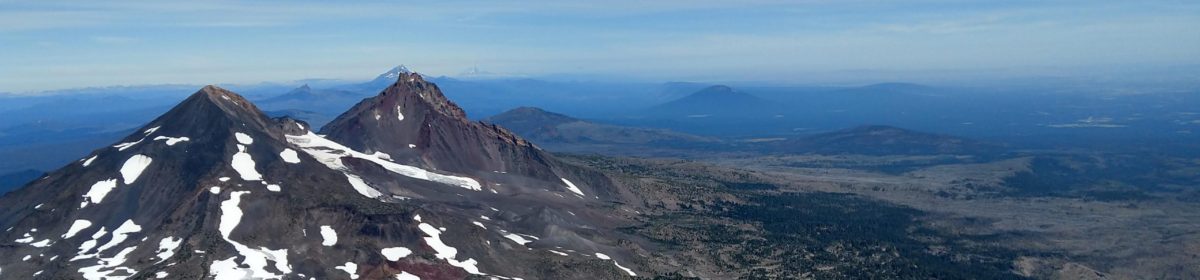

At first glance, a visit to Barnes Butte in Prineville looks a lot like much of central Oregon—a landscape of sage brush, juniper, and volcanic rimrock. It is difficult to imagine that Barnes Butte is, in fact, the inside edge of a massive supervolcano that—though now extinct—erupted more than 240 cubic miles of material forming a caldera roughly 29.5 million years ago.
Approximately 25 miles by 17 miles in size, the oblong-shaped Crooked River Caldera reaches from Smith Rock State Park in Terrebonne east to the Ochoco Reservoir and south to the Prineville Reservoir and Powell Buttes. For something so large, it might seem surprising that it wasn’t until 2005 that a couple of scientists first noticed its presence.
However, standing in the parking lot of Barnes Butte City Park with Carrie Gordon, a retired geologist, and willing hiking partner, it became obvious why such a large geological structure went unnoticed for so long. Seriously, what volcano?
The Hike
- Trailhead: Barnes Butte Trailhead
- Distance: Varies. (2.7 miles w/565 feet elevation to top)
- Details: Large parking area; no pass required; No restrooms (port-a-potty may be available)
Introductions
It was a warm early fall day when I met Carrie in the parking lot of Barnes Butte City Park. Wildfire smoke created a haze across the skyline, but you could still just make out most of its features, including the Cascade Volcanoes in the distance.
Carrie, a small energetic woman, was all smiles as we gathered at her vehicle for introductions.
“I worked 40 years for the Forest Service,” Carrie said, “As a forest geologist.”
She explained that her job mainly entailed keeping track of material sources, like gravel.
“It is one of those careers that are just a hoot and a half,” she exclaimed.
Yes, this is Carrie. And we were just getting started.
Tall Tales
I asked Carrie to tell me about where we were standing. After all, I couldn’t see any so-called “volcano.” She quickly pulled out her geology maps from her vehicle to orient me to the space and began to weave the tale.
“Jason McClaughry and Mark Ferns from DOGAMI started mapping in 2005,” she said. Originally, “they were supposed to map a 7.5-minute quadrangle,” Carrie continued.
Plans quickly changed, however. McClaughry and Ferns were tasked with finding water resources for Prineville, but while mapping, certain geological features started reshaping their goals. By the end of the project, they had mapped over 903m2—and reshaped our understanding of central Oregon geology.
“The cool thing about geology,” Carrie began, “The rocks don’t change but the story changes. We add to our body of knowledge, and we can go, ‘oh okay’…”
Anatomy of a Calderas
Perhaps the most important change to the story that McClaughry and Ferns brought to light was the chapter on the Crooked River Caldera.
“Calderas are a little sneaky,” said Carrie.
Unlike, the very conspicuous Cascade peaks, “seeing” a caldera requires reading the landscape very differently. They are not peaks, rather, Calderas are mostly depressions.
Carrie explained: “Basic caldera formation is you have magma that is coming up to the Earth’s surface to the point you get a collapse.”
In the case of the Crooked River Caldera, these eruptions took place from about 29.7 to 27.5 million years ago. These were massive eruptions of rhyolitic lava, including volcanic tuff, that created a void below the volcano that eventually collapsed creating a 26 by 17-mile depression.
In addition, a ring fracture develops during caldera formation—allowing rhyolitic lava to intrude and bulge up along the side of the collapse.
Evidence of the ring fracture of the Crooked River Caldera can be seen at places like the Prineville Reservoir and Peter Ogden Wayside, where older rock that pre-dates the eruptions is tipping toward the interior of the caldera.
In addition, and perhaps even more obvious, rhyolitic domes can be observed marking the Crooked River Caldera Boundary. Carrie pointed to each—Powell Butte, Gray Butte, Grizzly Mountain, and, of course, Barnes Butte.
“This is the evidence that they [McClaughry and Ferns] found,” Carrie stated.

Tuffs
I was beginning to see it—with many of the peaks visible from the parking lot—the caldera was taking form when Carrie whipped out another visual aid.
“I brought my box of rocks too,” she proclaimed.
Carrie pulled out two rocks with large flecks of material embedded within them—tuffs, I would soon find out.
“The cool thing about tuffs is they tell you about volcanic activity,” said Carrie. Tuffs are commonly associated with large violent eruptions as you see in caldera-forming.
“Tuffs are formed from bits and pieces of pumice and bits of rocks as it comes up through, in our case accreted terranes,” during an eruption, said Carrie. “It is a mishmash of stuff.”
Pulverized stuff mostly, like ash, but also some solid flecks of rock, like pale gray pumice, embedded in the matrix—that is tuff.
“It sparkles at you due to the crystal fraction in the ash,” described Carrie holding up two samples, her eyes sparkling more than the rocks.
Tuffs are also lighter than other forms of igneous rock, like other forms of rhyolite and basalt, as they are full of air pockets. She handed me one of the tuffs to weigh in my hand and basalt in the other—yep, I could feel the difference.
If you ever visited Smith Rock State Park, you have seen tuff. It is the tuffs that people mostly climb on.
“Easy to pound in your pins,” Carrie remarked.

Geochemistry and Cooling
Carrie had other rock samples in her box. She pulled out a shiny, black rock called obsidian, and a striped rock called banded rhyolite.
“These are all rhyolite geochemistry,” said Carrie. “Rhyolite has higher silica content than basalt and it tends to be blocky when it chills.”
However, the similarities end there.
“The thing about rhyolite is it comes in so many different forms.”
Tuff is the result of violent eruptions that pulverize rock, while obsidian and banded rhyolite are both formed as lava flows.
Obsidian is glassy because it cooled quickly enough that crystals were unable to form. Banded rhyolite, on the other hand, forms crystals that capture the layering that often occurs as lava flows.
“This is what makes up Grizzly and Gray Butte…” Carrie added, holding up the banded rhyolite.
She continued, holding up the two tuffs she had pulled out originally.

“These are the same rock,” she explained. Only one had undergone a form of hydrothermal alteration, turning it “pistachio green,” while the other more “beigy” rock had not.
“And that is tuff,” Carrie concluded, putting her rocks back in her box.
She also mentioned granite—another form of rhyolite formed by a slow cooling process under the Earth’s surface.
“It is the same composition as obsidian,” Carrie reiterated, but “buried a long time.”
Just one more reminder to not take your rhyolite for “granite” (pun intended).

Off to the Races
At this point, we had been chatting for about 20 minutes and decided it was about time to hit the trail. The trail system at Barnes Butte City Park is rather extensive, but we kept it simple and headed up the Jockey Trail that goes along the base of Barnes Butte—an old trail that the landowners used to run horses on.
As we started off on the rocky, dusty path, Carrie told me about the other trails that run through the park.
Apparently, much of the land was an old ranch. In addition to hiking the old horse track, there are also a lot of old cattle trails that are now hiking/biking trails that run through old grazing fields and around what used to be an irrigation pond.
Before that, there was even mercury mined on the Butte for a short time.
“See the main draw,” she said looking up toward the butte, “ there is an old BLM road that goes up to where the mercury mines in the 1940s are…. [The mercury mine is] courtesy of the caldera and volcanism.”
Mercury, lead, and gold, as well as Oregon’s state rock, the thunder eggs, rely on silica-rich waters to concentrate and form these minerals.
“You can take a footpath to the top of the butte,” Carrie added, “there are a lot of options.”
Rivers in the Sky
Soon we arrived at an embankment, apparently part of the old irrigation pond, when Carrie unexpectedly began hiking off the trail up the hill.
“What are you seeing?” she asked me, as I followed her onto the side of the embankment.
“Looks like some kind of layer of fine sandy stuff…” I responded hesitantly, “Oh, and the rocks are rounded.”
“You got it!” she proclaimed with a smile. “So, what we are seeing is lakebed and riverbed sands and cobble.”

Then turning, she pointed out to a suite of rimrock, lava plateaus.
“If you look across at our plateaus,” she explained, “you are looking at the old valley floors!”
She explained that each lava plateau was the result of an individual basalt eruption event (part of the Deschutes formation) that filled the valley at that point in time—the oldest being 7 million years old and the youngest only 3 million years.
Over time, the land area surrounding the lava-filled river channels eroded. As a result, what were once lowlands and river channels, are now basalt plateaus.
“This is inverted topography,” said Carrie—what was low is now high.
“What we are looking at here is the infill,” said Carrie looking back to the sand and cobbles, “the eroded remains of a valley bottom.”

Perspectives
Carrie and I continue wrapping up and around the hill of infill where we could get a better view of the young lava flows and the much older rhyolite buttes of the Crooked River Caldera.
As we hiked, we passed by some bright yellow rabbitbrush still in bloom. Carrie told me how she uses it to make cloth dye; and we briefly got on a tangent regarding natural dyes—a side passion of Carrie’s.
“Rabbitbrush makes the best dye!” she proclaimed.
Speaking of color, Carrie pointed out a pale green patch of ground in the distance—to the left of Barnes Butte from where we stood.
She told me how she used to drive by and wondered at the green color—“it just stayed pistachio green” all year long. Eventually, she realized it was tuff.
Though the rock that makes up Barnes butte is a solid rhyolite dome, tuffs can be observed around Barnes Butte as a few outcroppings, and as what geologists call “float”—rocks that have moved from their place of origin.
Carrie pointed out a few outcroppings of Barnes Butte tuff that lay just in front of us—“the high points,” she noted.
A Step Back
Carrie also addressed the hills that lay on the far horizon, outside the Caldera’s boundary.
“Most of what we are looking at on the far horizon are Clarno andesites,” said Carrie looking east—volcanic rocks from a period preceding the Crooked River Caldera eruptions.
Of course, mixed up in all of it, is even older rocks. Accreted terranes—jumbles of earth materials that become permanently attached to a land mass of a completely different origin—make up the basement rocks of Oregon.
Carrie told me about how older maps used to show a pocket of limestone in the area. It was “weird” at first, but as Oregon’s geological story unfolded it became apparent that the limestone was from an accreted terrane. The limestone would have come from some distant shallow sea before it was added to the continent 100 to 400 million years ago by the forces of plate tectonics.
Only later it became part of the Crooked River Caldera. The past, literally, resurfacing by way of the Caldera’s eruption.
Flash Forward to Newberry
Carrie turned to face the interior of the Caldera again. There was still one more point in time to discuss.
In addition to the lava flows that make up many of the plateaus around Prineville, an even younger period of volcanic eruptions graced the Caldera in geologically recent times—the Newberry Volcanics.
Newberry has been erupting for the last 400,000 years and remains active today. Its most recent eruption was 1,300 years ago.
“Darn it all!” she exclaimed. “I was hoping it would be clearer…It [Newberry] is a big shield volcano,” said Carrie, “It barely shows over the horizon.”
Interestingly, some of Newberry’s flows reached into the Crooked River Caldera.
Carrie described one of these flows:
“That basalt flow was going down the ancestral Deschutes River, near O’Neil Junction, where it dropped into the Crooked River drainage, headed to Smith Rock. Here it smacked into Smith Rock pushing the Crooked River over to its present course.”
Those who have visited Smith Rock State Park and hiked any of its trails know this basalt flow as the calf-burning, heart-pumping climb out of the Crooked River Canyon, and back to the parking lot.
Next time you visit, “Look at what is at the bottom of the basalt flow…” advised Carrie. “There is river cobble there.”
Whether it is the Newberry basalt flow, or any one of the other flows that passed through, each time the Crooked River is displaced.
“It was doing its level best to be a valley bottom and these stupid basalt flows come in,” Carrie described in her own colorful way. “The river is like ‘okay, I will find another route’.”
Ashes to Ashes
At this point, Carrie and I resumed our walk along the old racetrack and took a left, wrapping around to the other side of the embankment facing Barnes Butte. Song birds flitted by as we walked.
“One of the best-kept secrets,” Carrie shared, “we have a nesting osprey pair here.”
As we meandered around the bend, Carrie pointed out what looked like really fine sand.
“This is volcanic ash,” she explained. “When Mazama erupted, we got a foot and a half of fine ash.”
Mount Mazama—a massive stratovolcano blew it’s top 7,700 years ago, forming a smaller caldera that has since filled with water forming Crater Lake.
Carrie continued: “One of the things that happened is the winds will blow ash and it will catch on the leeward side of the hill,” she explained.
Carrie then proceeded to scoop up a handful of the ash and show how me how to look at it with a hand lens—white pumice fragments and black hornblende or magnetite could be made out among the grains. Of course, her favorite part, and mine too, was to look at the ash in the sunlight.
“The best thing about volcanic ash is it winks at you,” said Carrie. “It is the reflection of the crystal fragment of volcanic ash.”
You don’t get that same winking with sand, explained Carrie. Only ash has the ability to sparkle.

Blowing in the Wind
The ash is also important to the soil of the area. Loess—windblown sediment—is rich in many minerals and provides the starting material from which soil forms.
Of course, loess is not the only input into the area.
“Don’t forget we are in this pocket here,” reminded Carrie, “We had all the river systems and lake deposits that are actual sand and gravel.”
Alluvium—water-transported sediment—also contributes to soil formation, even in places you might not expect. Powell Butte, for example, is mostly covered with river sand.
“Something [i.e., a river] was moving across there at one time,” said Carrie.
Now, these old river channels are a ready source of water for the City of Prineville. When the City looked for places to tap for wells, surprisingly the best places were on the bottoms of the lava flows that once were river channels.
“This was the thing that blew me away,” Carrie smiled.
Barnes Butte
Carrie and I reached another junction and took the trail heading up Barnes Butte. As we climbed, we passed by several large hunks of reddish-brown rock. Unlike the rocks down below, these were not round, but jagged.
“All the hunks of rock are rhyolite,” said Carrie.
I asked Carrie how she knew it was rhyolite, aside from knowing where we are at. Carrie picked up a piece of the rock and knocked it against another.
“It sounds glassy,” she explained. “Part is how it sounds, and if you can heft it.”
According to Carrie, compared to basalt, another prolific volcanic rock, rhyolite is not as heavy. So if you find a gray rock that is relatively lighter and glassier, it could be rhyolite.
Juniper
As we continued up the rocky hill Carrie, I noticed a juniper with its roots clinging to a juniper tree.
Off-hand I asked Carrie, “Do junipers like rhyolite?”
Surprisingly, she answered in the affirmative.
“That’s a cool story!” Carrie proclaimed. “Western Juniper has become invasive.”
Though western juniper is a species native to central Oregon, it has been creeping into areas that it normally wouldn’t. Fire exclusion, grazing pressure, and climate variability have all been cited as reasons for the spread of the waster juniper.
“And it uses a lot of water,” Carrie added, a highly valued resource in the area.
“This is all rangeland,” Carrie explained, it should have “more grasses and sagebrush component.”
In short, western juniper shouldn’t be so prevalent.
Instead, according to Carrie, western juniper is a first colonizer. Its range historically was limited to rocky areas—like our rock-grasping juniper.
“This is a rhyolite knob,” concluded Carrie, “and this is a very well-behaved juniper.”

Lichen
We continued up the Barnes Butte for a stretch but then decided to turn around. I was curious about finding tuff, so Carrie suggested we check the lower trail.
As we walked, I started noticing all the lichen and moss growing on the rhyolite and asked Carrie about it.
“Are they picky?” I asked, wondering if only certain lichen grow on certain kinds of rock.
Carrie didn’t think so, but instead mentioned how they might be used to age-date rocks.
Estimates of the age of a rock can be estimated based on the growth and size of the lichen that grows on it.
“Has the rock been sitting in place?” Carrie asked rhetorically. “Then you can get some age dates.”
Additionally, some plants do seem to prefer certain rock types. During the mapping of Mill Creek—an area adjacent to the Crooked River Caldera—McClaughry and Ferns found that, following a fire, much of the rhyolitic rocks were being colonized with manzanita. Manzanita soon became an indicator of rhyolite geology during the mapping.

Recommendations
As we continued downhill, Carrie spotted some of the green tuff as float (loose rock) along the pathway—more evidence that we were, in fact, in a Caldera.
As we walked, Carrie offered me a lot of recommendations—video recommendations, places to visit, and hikes to take. She had a real knack for suggesting hikes I hadn’t been on.
But perhaps the strongest suggestion she has was to check out some of the Crooked River Caldera sites.
One of these places was Pilot Butte. (Yep, I hadn’t hiked it yet.)
You can see the Cascade Volcanoes from Pilot Butte—” a lovely white line of volcanoes,” as Carrie put it, but she wanted to make sure I didn’t miss the main event.
“It [the Crooked River Caldera] is one huge volcano compared to the pretty pristine cones,” she added.
Other places she recommended for observing attributes of the Caldera include the Prineville Reservoir, Peter Skene Ogden State Park, Ochoco Reservoir, and, of course, Smith Rock.
I recommend hiking with Carrie. She is a hoot-and-a-half.
Carrie Gordon is a retired forest geologist. She was the Forest Geologist on the Ochoco National Forest and Crooked River National Grassland, U.S. Forest Service, headquartered in Prineville, OR. She retired in 2017. Carrie is also an active member of the Central Oregon Geoscience Society and an Oregon Master Naturalist through the OSU extension program. Carrie has had a life-long fascination with the land and the rocks, listening to the stories they tell.